
Has AI Made It Easier to Make Bad Ideas Look Convincing?
Context
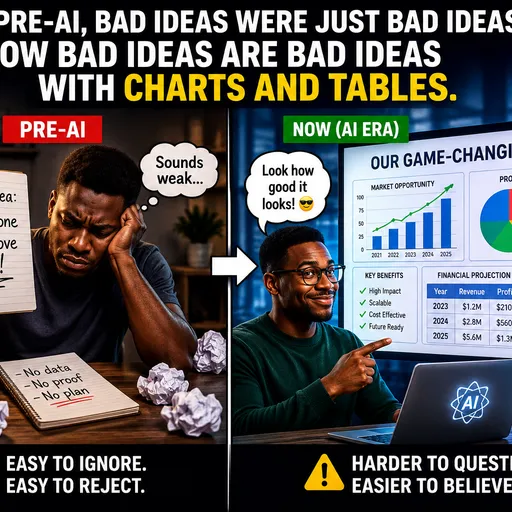
Before AI tools became widespread, weak ideas often failed because they lacked structure, presentation, or supporting analysis. Now, almost anyone can generate polished reports, charts, tables, and professional-looking arguments within minutes. Has this changed how people evaluate quality and credibility? Are presentation and data visualization starting to outweigh actual critical thinking? And how can people distinguish between genuinely strong ideas and poorly thought-out concepts packaged professionally by AI?
Top answers
Uduak Effiong
@uduakeffiong367• 3w ago
You have hit on a critical shift in the modern workplace where the barrier to producing high-quality presentation layers has effectively vanished. It is true that AI creates a veneer of authority that can mask flawed logic, leading to a landscape where surface-level polish often gets mistaken for analytical depth. Because of this, the burden of proof has shifted squarely onto the consumer to look past the beautiful charts and interrogate the raw assumptions and data sources driving the conclusions. To navigate this, try asking for the underlying data sets or the specific chain of reasoning used to reach a result, as these are much harder for AI to fabricate consistently than a polished summary. Ultimately, critical thinking is becoming a more valuable differentiator than ever, and we must treat professional formatting as a starting point for evaluation rather than a stamp of quality.
Comments
Chukwudi Okafor
@chukwudiokafor656• 3w ago
This is such a sharp point about the difference between polish and substance. I have definitely noticed that a well-formatted slide deck can now make even the most hollow strategy seem legitimate at first glance. Your advice about asking for the raw chain of reasoning is a great practical tip for cutting through that noise. Do you think this shift will eventually lead to a change in how we structure meetings, perhaps moving away from presentations toward more interactive data reviews?